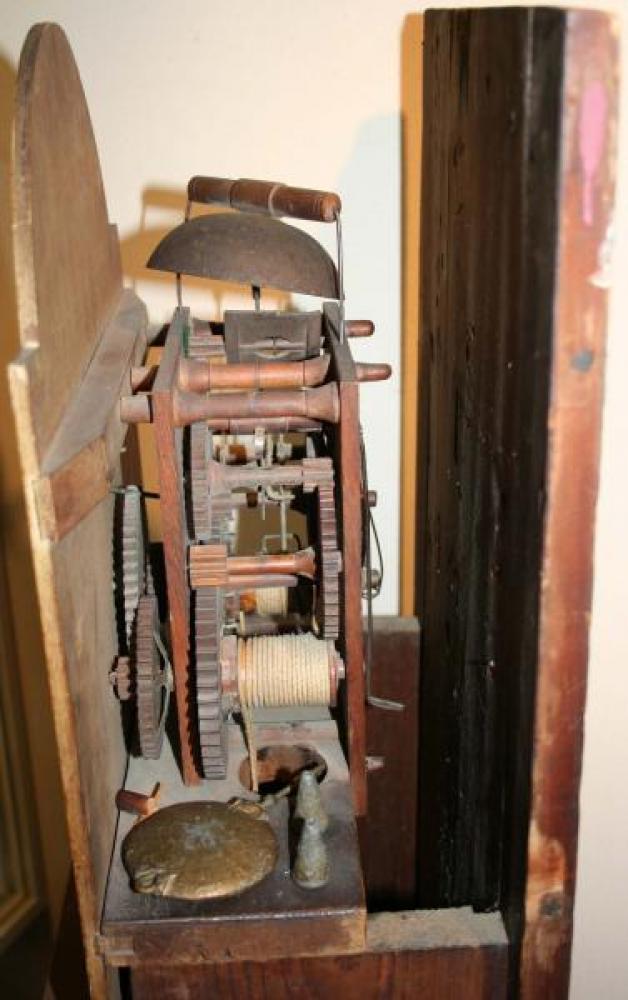
Shown in this Gallery from the museum's collections are some pictures of 1820s and 1830s wood-gears clocks with Canadian labels.
Before about 1840, rolled sheet brass was an expensive material imported into North America from England. Early clock movements were custom made one tooth at a time, one gear at a time - the costs of labour time and materials were both high. The result was that only rich people could afford a clock.
To get around this brass "problem", beginning in the mid 1700s some American clock makers started to use local woods - oak and finer-grain cherry - to make the plates and gears, respectively, for some tall case clocks. Eli Terry in Connecticut patented a wood-geared 30-hour, weight-driven movement for mantel clocks in 1816. This led to the "mass-produced" classic pillar & scroll clock case with its interchageable-parts movement that became very popular in the 1820s as the affordable clock for many middle class families. The museum has an example with a case made in Nova Scotia and the movement (probably) imported from Eli Terry's factory (see pictures).
In the 1820s/30s thirty-hour, weight-driven wood movements were being used in eastern North America in low-end floor clocks with pine cases painted to look like mahogany wood. The weights were typically metal cans filled with stones, and were pulled up daily by their cables. No key was needed - the winding holes on the hand-painted wood dials were fake! This was the lowest cost floor clock available.
Several Twiss brothers came up to Montreal, Lower Canada, from Connecticut in the mid / late 1820s to set up a factory to produce grain-painted pine cases for floor clocks for the Canadian market. The thirty-hour, weight-driven wood movements were imported from a Connecticut factory. The museum has examples by JB & R (Joseph and Russell) and I (Ira) Twiss. (see pictures).
The 1830s brought a change in mantel case style to the larger, half columns and splat top mantel clock that typically had a mirror in the lower section of the door. Wooden gears and cast iron weights were still used to drive the clock's time and strike gear trains. The museum has examples from sellers in Nova Scotia, Lower Canada, and Upper Canada (see pictures).
Starting around 1840, Seth Thomas in Connecticut began using locally produced sheet brass to make his clock movements. The parts were stamped out and therefore interchangeable, which greatly reduced the manufacturing cost of clocks and hence the price to the public.
The museum's collection of Canadian-label clocks from this time period - SHOWN IN A SEPARATE GALLERY - includes examples of Seth Thomas 30-hour and 8-day weight-driven, brass movement mantel clocks that were imported into Canada West up to the 1860s. These EXTRA NO. 1 BRASS CLOCKS were sold mostly by peddlars to customers in Leeds County (east of Kingston) and in the Toronto and Hamilton areas in the 1850s and 1860s. Peddlars' names included Van Tassel, Southworth, Field, and Abel.
| 
 A Proud Canadian Web Site